







Product Lifecycle Management: Complete Guide
Today’s consumers want new products more often, making speed to market more important than ever before. Product lifecycle management gives you one structured way to manage a product from first concept through to the day it leaves the range. For brands selling on marketplaces, that matters more than it used to.

Your product data is no longer just an internal record. It is the listing, the search result and, increasingly, the evidence a regulator expects to see. When that data sits in twelve spreadsheets and four inboxes, speed to market suffers and so does everything downstream of it.
What is product lifecycle management (PLM)?
Product lifecycle management is the practice of managing every stage of a product's life, from conception through development, launch, growth and eventual retirement, using a single connected set of data and workflows. It is both a discipline and a category of software. The discipline sets out who decides what, in which order. The software gives those decisions one place to live.
Product information is usually scattered across disparate teams, systems and file shares. PLM brings that data together so engineering, manufacturing, supply chain and commercial teams work from the same version. For brands that sell online, PLM sits upstream of the commercial systems that turn a product record into a listing, which is where a product experience management platform takes over.
PLM supports a wide range of processes, including:
- Bill of materials (BOM) management: Keeping component and material structures accurate across revisions.
- Product cost estimation: Modelling landed cost before a product is committed to production.
- Risk assessment: Identifying safety, supply and regulatory exposure early.
- Go-to-market planning: Aligning launch dates, markets and channels.
- Marketing and promotional strategy: Connecting product claims to approved source data.
- Selling strategy: Deciding which variants go to which market.
- Expansion planning: Preparing a product for new territories and regulatory regimes.
- Phase-out planning: Managing discontinuation, spares and disposal.
It is particularly valuable in manufacturing, retail, automotive and consumer goods, where product structures are complex and the cost of getting a specification wrong is high.
According to CIMdata, the global PLM market reached 80.3 billion US dollars in 2024, growing 10.7 per cent year on year, with EMEA forecast to reach 39.6 billion by 2029. This is a mature, well-established software category rather than an emerging one.
What is the difference between the PLM process and PLM software?
The difference between the PLM process and PLM software is that the process defines how product decisions are made and approved, while the software enforces and records those decisions. You can run a PLM process without dedicated software, using documents, shared drives and meetings. Most organisations do exactly that until product complexity outgrows it.
Product lifecycle management software adds version control, audit trails, approval workflows and structured product data that other systems can read. That last point matters most for ecommerce. Software product lifecycle management only creates commercial value when the data it holds can leave the system cleanly and arrive somewhere useful, whether that is an ERP, a webshop or a marketplace listing.
What are the stages of the product management lifecycle?
The stages of the product management lifecycle are development, introduction, growth, maturity and decline. The model has been used in commercial strategy since Theodore Levitt set it out in the Harvard Business Review in 1965, and it still holds because it describes demand rather than technology.
Each PLM stage asks a different question of your product data, and a PLM system is what keeps the answers consistent as the product moves between them.
Product development
Product development covers everything that happens before manufacturing begins: idea generation, market research, specification and prototyping.
A PLM system supports this stage by centralising product data, managing version control and letting design, engineering and commercial teams work in parallel without overwriting each other. The cost of a change is lowest here, which is why the quality of the data captured at this point sets a ceiling on everything that follows.
Product introduction
Product introduction begins once design is approved and production starts, alongside launch marketing and the first customer orders.
PLM helps by tracking manufacturing progress, holding regulatory documentation against the product record and keeping engineering, production and marketing working from the same specification. Any inconsistency between the technical file and the published product description will surface here first.
Product growth
Product growth is the stage where demand accelerates and your production and distribution strategy has to keep up. PLM systems support this by managing supply chain requirements, handling engineering changes driven by customer feedback and keeping variant data under control as the range expands.
Growth is also where product data errors become expensive, because they replicate across every new channel you open.
Product maturity
Product maturity is the stage where sales peak, competition intensifies and margin protection becomes the priority.
PLM supports this phase through change management, quality control and compliance across the markets you sell in. Most of the lifetime value of a product is realised here, so the work shifts from creation to careful maintenance.
Product decline
Product decline is the stage where demand falls and you decide whether to retire the product or refresh it. PLM systems help with discontinuation planning, parts and spares availability, warranty obligations and end-of-life routes such as recycling or remanufacture.
Retiring a product properly is a data exercise as much as a commercial one, because listings, assets and compliance records all need to be withdrawn in step.
How does a product lifecycle management system work?
A product lifecycle management system works by acting as the single source of truth for product data, with every team reading from and writing to one governed record rather than their own copy.
Around that record sit workflows, permissions and approval gates that control who can change what, and when. The PLM system does not replace your other systems. It feeds them. In practice, a PLM system does four things. It stores the definitive product record, including specifications, BOMs, documents and revisions.
It controls change, so no revision is made without a trace of who approved it. It connects the teams that touch the product, so engineering and commercial are never working from different versions. And it distributes structured data outward to the systems that need it.
The result is fewer errors, faster development cycles and decisions based on data that everyone agrees is current. That is the whole PLM process in one line: get the product right once, then make sure every system and every channel reflects it.
How does PLM differ from PDM, ERP, PIM and PXM?
PLM differs from PDM, ERP, PIM and PXM in scope and in the moment of the product's life each one serves. They overlap enough to be confused with each other and are different enough that choosing the wrong one leaves a gap. The simplest way to separate them is to ask what question each system is built to answer.
What is the difference between PLM and PDM?
The difference between PLM and PDM is that product data management handles technical product data such as CAD files, drawings and document revisions, while product lifecycle management covers the full commercial and operational life of the product around that data. PDM is a component.
PLM is the framework it sits inside. Many organisations start with PDM and extend into PLM as the questions they need answered move beyond engineering.
How does PLM work with an ERP system?
PLM works with an ERP system by defining the product and handing the resulting record to ERP to be planned, procured, costed and fulfilled. PLM answers what the product is; an enterprise resource planning system answers what it costs and where the stock is.
The integration between the two is usually the first one an organisation builds, because a product that exists in PLM but not in ERP cannot be bought or sold. Two further integrations matter for most businesses.
Manufacturing execution systems connect the product record to shop floor operations. Supply chain management systems use it for supplier collaboration, demand forecasting and logistics planning. Customer relationship management systems close the loop, feeding customer insight back towards development.
Where do PIM and PXM fit into the product lifecycle?
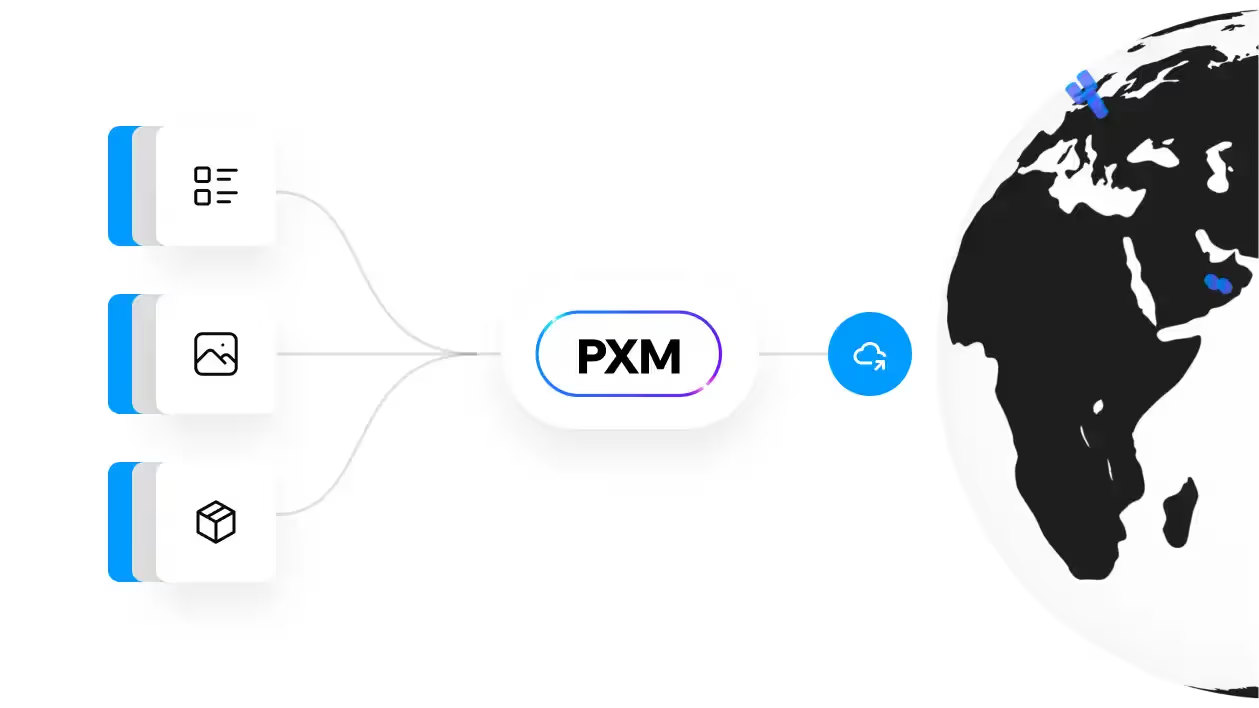
PIM and PXM fit at the commercial end of the product lifecycle, taking the approved product record and turning it into content that sells. Product information management holds the marketing-facing attributes: descriptions, images, channel-specific fields and translations.
Product experience management goes further, optimising that content for each channel and syndicating it to every destination that needs it. The distinction is worth being precise about, because it defines where PLM stops.
PLM makes sure the product is right. PIM and PXM make sure the market sees it that way. A brand can have an immaculate PLM implementation and still lose the buy box, because nothing in the PLM system knows what an Amazon browse node is or how a Zalando attribute set is structured.
Why does the product lifecycle work differently on marketplaces?
The product lifecycle works differently on marketplaces because a product occupies a different lifecycle stage in every market at the same time. A skincare line in decline in the UK can be introduced in the UAE and in growth on Tmall.
The classic model assumes one curve. Selling across borders gives you a separate curve per channel, and each one needs its own content, pricing structure, stock position and compliance evidence.
That has three consequences for how you manage product data. Retirement stops being a single event, because a product you withdraw in one market may still be your priority launch in another. Content requirements multiply, because every marketplace has its own attribute schema and no PLM system speaks all of them natively.
And the volume of change becomes unmanageable by hand, which is why content management and optimisation is usually the first thing brands automate once they pass a few hundred SKUs across several territories.
This is also where the value of good lifecycle data becomes visible commercially rather than operationally. Accurate, complete, channel-ready product data is what makes a listing findable, and findability is the input to everything else.
How does lifecycle data affect market access in the UK and EU?
Lifecycle data now affects market access directly, because EU regulation increasingly makes structured product information a condition of being allowed to sell rather than a matter of good practice. For UK brands selling into the EU, this is the single biggest change in how product data is treated, and it lands squarely on the systems that hold it.
Two frameworks matter most right now. The General Product Safety Regulation, Regulation (EU) 2023/988, has applied since 13 December 2024. It requires specific safety and traceability information to appear on online listings, and non-compliant products can be removed from marketplaces.
UK businesses without an establishment in the EU or Northern Ireland that sell to EU consumers may need to change how they operate to meet it. The second is the Digital Product Passport under the Ecodesign for Sustainable Products Regulation. The European Commission's DPP Registry became operational on 20 July 2026.
The first legally fixed deadline is the battery passport: under Article 77 of Regulation (EU) 2023/1542, it applies from 18 February 2027 to light means of transport batteries, industrial batteries above 2 kWh and electric vehicle batteries.
Other categories follow through delegated acts under the ESPR Working Plan 2025 to 2030, adopted on 16 April 2025, with textiles and apparel expected next and roughly 18 months to comply once the relevant act is published.
Both point in the same direction. Material composition, durability, sourcing and end-of-life information are lifecycle data, held in PLM, but they have to arrive on the digital shelf in a structured, machine-readable form. Brands treating this as a sustainability reporting exercise rather than a product data exercise are solving it in the wrong system.
When do you need a product lifecycle management solution?
You need a product lifecycle management solution when the cost of coordinating product information manually starts to exceed the cost of the system. That threshold is different for every business, but the signals are consistent. Ask whether any of the following describes you:
- You are growing or diversifying: More products, more variants and more markets make manual coordination progressively less reliable.
- Compliance is becoming a burden: You are assembling the same evidence repeatedly because nobody can find the last version.
- Your production process is complex: Multi-level BOMs, several suppliers and frequent engineering changes.
- Your product data is siloed: The same attribute exists in four systems with three different values.
- Development is slow or disorganised: Launches slip because approvals sit in inboxes.
If several of these apply, a lifecycle management product is likely to pay for itself in avoided rework alone. If only one does, fixing the underlying process is usually the better first move.
What should you look for in product lifecycle management tools?
The things to look for in product lifecycle management tools are integration depth, data model flexibility and how easily information leaves the system. Feature lists across vendors converge quickly.
What differs is whether the platform fits how your business actually works and whether it can hand structured data to the systems downstream of it. Assess any product lifecycle management platform against four criteria.
First, can it model your product structure without heavy customisation. Second, does it integrate with your ERP and commercial systems through supported connectors rather than bespoke development. Third, does it export data in a form your channels can consume. Fourth, will your teams actually use it, because a PLM system that people work around is worse than no system at all.
What are the benefits of product lifecycle management?
The benefits of product lifecycle management come from removing duplicated effort and ambiguity from product decisions. Most of them are efficiency gains rather than revenue gains, which makes them easy to underestimate and easy to measure once you look.
- Fewer errors: Centralised data and automated workflows reduce miscommunication, version control problems and design mistakes before they reach production.
- Faster time to market: Real-time collaboration and automated approvals shorten the path from concept to launch.
- More predictable delivery: Structured workflows and clear documentation make roadblocks visible early enough to act on.
- Better collaboration: Engineering, manufacturing, marketing and supply chain work from one record instead of four.
- Greater efficiency: Repetitive tasks are automated and processes standardised across sites and regions.
- Stronger product quality: Performance, compliance and customer feedback are tracked against the product record, so improvements are evidence-based.
The product lifecycle management benefits that tend to matter most commercially are the compound ones. Cleaner data upstream means fewer listing defects downstream, and fewer listing defects means fewer suppressed products and less time spent on corrections.
How do you measure the success of product lifecycle management?
You measure the success of product lifecycle management with a small set of operational indicators tracked before and after implementation. Vanity metrics such as number of records migrated tell you nothing about whether the system is working. These five do:
- Time to market: The reduction in development cycle length from concept to launch.
- Cost efficiency: Reduced waste, rework and duplicated effort across teams.
- Quality: Defect rates and the number of compliance issues raised after launch.
- Collaboration: Approval cycle times and the volume of work returned for rework.
- Customer experience: Return rates and product-related complaints.
Set the baseline before you start. Most organisations that struggle to justify their PLM investment do so because nobody recorded what the process cost beforehand.
It is also worth being clear on PLM roles and responsibilities from the outset, because unowned data goes stale faster than any system can compensate for.
What are the best practices for product lifecycle management?
The best practices for product lifecycle management are less about the software and more about the discipline around it. A well-configured system on top of an unclear process will simply make the confusion faster.
Start with a defined data model and a named owner for every product attribute. Agree the approval workflow before configuring it, rather than automating whatever happens today.
Migrate clean data only, because importing legacy inconsistencies is how a fresh system inherits an old problem. Integrate outward early, so the PLM record reaches ERP and your commercial systems from the beginning instead of becoming an isolated archive.
And treat adoption as part of the project rather than a training afterthought. If you are moving from planning to execution, our guide to PLM implementation covers the steps and pitfalls in detail.
What is the future of product lifecycle management?
The future of product lifecycle management is being shaped by automation, connected products and regulation that demands structured lifecycle data. The direction of travel is consistent: more of the product record generated automatically, and more of it required to be shared outside the business.
AI and machine learning
AI and machine learning are changing PLM by automating routine data work, flagging likely quality or supply issues before they occur and suggesting improvements from historical product performance. The practical near-term impact is in data enrichment and anomaly detection rather than in design itself.
IoT and connected products
Connected products feed real-world usage, performance and condition data back into PLM systems. As more categories ship with connectivity, that feedback loop shortens the distance between what was designed and what is known about how it performs, which improves maintenance, updates and the next revision.
Cloud-based PLM
Cloud-based PLM gives distributed teams and suppliers access to current product data from anywhere, which removes a long-standing bottleneck in cross-border product development. It also lowers the integration barrier, since connectors to commercial systems are increasingly delivered as standard rather than built per customer.
Circular design and sustainability
Circular design is moving from ambition to requirement. PLM systems are becoming the place where material composition, carbon footprint, repairability and end-of-life routes are recorded, largely because Digital Product Passport requirements need exactly that data in a structured form. Designing for the full lifecycle is now a data obligation as much as a design philosophy.
Advanced product data analytics
Better analytics on top of a complete product record gives clearer insight into product performance, market trends and customer needs. The value depends entirely on data quality, which is the argument for getting the lifecycle record right before investing in the reporting layer on top of it.
How Pattern supports your product content across the lifecycle
Pattern does not sell a PLM system. What we do is take over the part that begins where PLM ends, turning your approved product record into accurate, optimised, compliant content on every marketplace you sell through.
Pattern PXM brings digital asset management, product information management, syndication and AI-driven content optimisation into one place, so the specification your teams signed off is the specification that reaches the customer. Today that platform manages 2.3 million product collections for brands selling in more than 50 countries.
For brands expanding across the UK, Europe and the Middle East, that gap between the product record and the live listing is usually where growth stalls. We close it as part of a wider partnership covering advertising, content, fulfilment and brand control across global marketplaces.
Want to see what that would look like for your range? Book a strategy call with our team.
Complementary Systems for Seamless Product Lifecycle Management


Frequently Asked Questions
What are the three main elements of product lifecycle management?
The three main elements of product lifecycle management are people, processes and technology. People are the teams and stakeholders who own product decisions. Processes are the workflows that take a product from idea to retirement. Technology is the software that holds the record and enforces the workflow. A weakness in any one of the three limits what the other two can deliver.
What is the difference between PLM and PIM?
The difference between PLM and PIM is that PLM manages the product itself across its entire life, while PIM manages the commercial product information used to sell it. PLM holds specifications, BOMs and engineering changes. PIM holds descriptions, images, channel attributes and translations. Most brands selling online need both, connected, rather than one instead of the other.
Why do PLM projects fail?
PLM projects usually fail because of weak planning and low stakeholder engagement rather than software limitations. Common causes are poorly defined objectives, migrating unclean legacy data, insufficient training and integration challenges with existing systems. Scoping the first phase narrowly, to one product category or one business unit, gives the wider rollout evidence to build on.
Does a Digital Product Passport require a PLM system?
A Digital Product Passport does not require a PLM system, but it does require the structured lifecycle data that PLM systems are designed to hold. Requirements are being introduced product group by product group under the ESPR, starting with the battery passport from 18 February 2027. Brands in affected categories should be identifying now where material, durability and end-of-life data currently lives and whether it can be exported in a machine-readable form.
What does a PLM system cost?
PLM implementation costs vary considerably with company size, product complexity and the solution chosen, so a single figure is not meaningful. Build your assessment from the components that actually drive it: licensing, data migration, integration with existing systems, configuration and training. Comparing vendors on total cost of ownership over several years is more useful than comparing licence prices.