





Enterprise Resource Planning: Complete Guide
Enterprise resource planning is how a business runs its core processes through one connected system instead of a patchwork of separate tools. This guide covers what an ERP system is, how it works and the types available. It also sets out how ERP differs from MRP, CRM and PIM, and what it does and does not solve when you sell across marketplaces.
What Is Enterprise Resource Planning?
Enterprise resource planning is the practice of running a company's core business processes through a single connected system. An ERP system collects data from finance, human resources, procurement, supply chain and sales, holds it in one shared database, and makes the same information available to every department that needs it.
The value comes from removing the gaps between systems rather than from any single feature. When finance, operations and sales each work from their own tool, the same order exists in three places and nobody is certain which version is correct. An ERP system makes one record the authoritative one.
Enterprise resource planning sits alongside a wider family of systems that manage product and business data. You can explore each of them in our library of ecommerce topics.
That single source of truth has a second effect: it reduces the number of platforms a business has to run. Fewer systems means fewer integrations to maintain, fewer places for data to drift out of sync, and less time spent reconciling numbers that should already agree.
What does ERP stand for?
ERP stands for enterprise resource planning. The term describes both the management approach, integrating core processes into one system, and the software category that delivers it.
Research firm Gartner introduced the term in the early 1990s, to describe software that had grown beyond manufacturing planning into a suite covering the whole organisation. In everyday use, "ERP", "ERP system" and "enterprise resource planning software" are used interchangeably.
How ERP grew out of MRP
Enterprise resource planning has a direct lineage that explains why ERP systems still look the way they do. Manufacturers in the 1960s adopted material requirements planning (MRP) to work out which components they needed and when. In the 1980s, MRP II extended that logic to production scheduling, shop floor control and capacity planning.
By the 1990s the same integrated approach had spread to finance, HR and procurement, and Gartner gave the broader category its name.
Two shifts have reshaped it since. Browser-based software made cloud deployment practical, which lowered the barrier to entry and moved maintenance to the vendor.
More recently, artificial intelligence and machine learning have been built into the systems themselves, moving ERP from a record of what happened towards a tool that anticipates what is likely to happen next.
How Does an ERP System Work?
An ERP system works by splitting the business into modules that all read from and write to the same database. Each module covers one area, such as financial management, procurement, inventory or human resources. Because they share a common data layer, an action in one module updates the others automatically.
Order fulfillment shows the effect clearly. Without an ERP system, sales records the order, the warehouse adjusts stock, and finance tracks the payment, each in a separate tool and each at a different moment.
With one, those become stages of a single workflow rather than three disconnected tasks. Automating the handovers removes manual data entry, which is where most of the delay and most of the errors come from.
The core modules of an ERP system
Most enterprise resource planning systems are built around a common set of modules, which businesses select from rather than buying wholesale. The finance module is the one constant: a suite without it is not usually considered a full ERP system.
- Financial management: General ledger, accounts payable and receivable, reporting and forecasting.
- Supply chain management: Procurement, supplier records, purchase orders and logistics planning.
- Inventory management: Stock levels, locations, movements and reorder points.
- Manufacturing and production: Bills of materials, scheduling and capacity planning.
- Human resources: Employee records, payroll, absence and performance data.
- Sales and order management: Quotes, orders, invoicing and returns.
- Reporting and analytics: Dashboards and KPIs drawn from every other module.
How ERP systems connect to other software
An ERP system rarely operates alone. It sits at the centre of a wider stack and exchanges data with the tools around it, including customer relationship management, product information management, warehouse management and ecommerce platforms.
That exchange is what turns a set of separate systems into one operating picture, and it is a project in its own right. Our guide to ERP integration covers the methods and the practices that make it work.
Access control matters as much as connectivity. Because an ERP system holds payroll, margin and supplier data in the same place as stock counts, user permissions decide who can see what. A well-configured system gives each role the data it needs and nothing beyond it.
What Types of ERP System Are There?
Enterprise resource planning systems are grouped in two ways: by how they are deployed and by the kind of business they are built for. The two questions are separate. A small business ERP can be cloud-based or on-premise, and an industry-specific system can be either as well.
ERP deployment models
Deployment describes where the software actually runs. It drives the level of control you keep and the amount of internal IT capability you need. There are four models in common use.
- On-premise ERP: The software runs on the company's own servers. It offers the greatest control and the widest scope for customisation, and it requires the largest upfront commitment in hardware, licensing and technical support.
- Cloud ERP: The software is hosted on remote servers and reached over the internet as a subscription. The provider handles security, maintenance and upgrades, which lowers the internal IT burden. This is now the default choice for most new deployments.
- Hybrid ERP: A combination of the two, keeping some functions on the company's own infrastructure while running others in the cloud. It suits businesses with specific data residency or security requirements.
- Two-tier ERP: A large organisation runs one system at head office and a lighter, often cloud-based system in subsidiaries or newly acquired businesses. It is common during expansion and after mergers, because it avoids forcing every entity onto one platform at once.
ERP systems by business fit
The second grouping is about scope and specialisation. It answers how much system you need rather than where it lives, and there are four broad categories.
- Tiered ERP: A platform with multiple levels of functionality, so you start with the modules you need and add more as you grow.
- Industry-specific ERP: A system built around the processes of one vertical. A distribution business needs depth in supply chain and inventory that a professional services firm has little use for.
- Open-source ERP: A system built on open code, chosen by organisations that want to build rather than buy. It allows extensive customisation and demands more specialist technical capability to run.
- Small business ERP: A lighter enterprise resource planning solution scoped to a smaller organisation, while still supporting activities such as regulatory reporting and structured data analysis.
How Does ERP Differ from MRP, CRM and PIM?
ERP is the broadest of these systems and the others each go deeper on one part of the business. MRP plans materials, CRM manages customer relationships, and PIM manages product content. The confusion arises because all four touch the same products and the same orders, but each holds a different version of the truth about them.
ERP vs MRP
MRP is a component of ERP rather than an alternative to it. Material requirements planning answers one question: do we have what we need to keep production running, and if not, when do we need to order it.
Enterprise resource planning answers that question too, then connects the answer to the purchase order, the supplier payment, the ledger entry and the customer order. Nearly every manufacturing ERP contains an MRP engine, so the practical decision is whether a standalone MRP tool still covers the business.
ERP vs CRM
ERP looks inward at how the business runs and CRM looks outward at how the business sells. A CRM holds the conversation history, the pipeline and the service tickets. The ERP system holds the order that conversation produced, the stock it consumed and the invoice it generated.
Many ERP suites include a CRM module, and many businesses run a specialist CRM alongside the ERP and integrate the two.
ERP vs PIM
This is the distinction that causes the most trouble in ecommerce, because both systems hold product data and they hold different kinds of it. An ERP system holds the operational and financial record of a product: its SKU, cost, stock position and supplier.
A product information management system holds the commercial record: the attributes, descriptions, images, translations and channel-specific variations that a shopper actually sees. The ERP knows a product exists and what it costs. It does not know how that product should be described on a German marketplace listing.
When Should You Consider an ERP System?
The signal to consider enterprise resource planning is usually operational rather than technical. The business starts spending more time keeping its systems in agreement than acting on what they say. Five questions tend to surface that point.
- Can our current systems and processes scale with the growth we are planning?
- Do we struggle to get accurate, real-time data across departments?
- Are there bottlenecks in day-to-day operations that hold back productivity?
- Is meeting compliance and regulatory requirements becoming more time-consuming?
- Are data silos or disconnected systems getting in the way of collaboration?
Start with how work actually moves. When a workflow gains another stakeholder, does it still run, or does someone bridge the gap with a spreadsheet and a manual export?
Patching systems together with manual data entry works at one scale and quietly stops working at the next. That threshold, rather than a particular headcount or revenue figure, is what makes the case.
Look next at how long it takes to answer a question about the business. If finding a figure means asking a colleague and waiting, the data is not accessible, it is merely stored somewhere. An ERP system makes it retrievable, tracks activity as it happens and leaves an audit trail behind it.
It is worth going into that decision with realistic expectations. In Panorama Consulting Group's 2026 ERP Report, more than a quarter of organisations exceeded their project budget, most often because additional technology turned out to be needed part way through.
The lesson is not that ERP projects go wrong, it is that scope is easy to underestimate. If you have reached the point of planning one, our guide to ERP implementation sets out the phases and the decisions involved.
What Is the Business Value of an ERP System?
The business value of enterprise resource planning comes from compounding small efficiencies rather than from one headline saving. Every manual handover removed, every duplicate record avoided and every report produced without assembling it by hand returns time to the people doing the work.
- Efficiency and productivity: Automated data entry and connected workflows let teams move faster without adding headcount.
- Better decision-making: A single source of truth means decisions rest on current data rather than on whichever export was most recent.
- Cost control: Consolidating overlapping tools reduces licence sprawl, duplicate entry and the rework that follows human error.
- Scalability: Modules, users and data sources can be added as the business grows, without replacing the foundation.
- Collaboration and visibility: Teams see the same project status, document and performance metric at the same time.
- Compliance and risk management: Every process and approval leaves a record, which makes audits and regulatory reporting less disruptive.
- Financial management and reporting: Transactions, cash flow and runway sit in one place, so budgeting and forecasting rest on complete figures.
Those benefits also reach the customer, indirectly but quickly. When service teams can see an order's real status rather than an estimate, they answer questions on the first contact instead of promising to check and call back.
Where Is ERP Used Across the Business?
Enterprise resource planning systems are used across almost every function that produces or consumes operational data. Common examples of enterprise resource planning systems at work include the following.
- General ledger and financial accounting: Accounts payable and receivable, revenue recognition and financial reporting in one place.
- Payroll and workforce management: Salary, leave, tax and performance records, plus a view of workforce trends across departments.
- Procurement and supplier management: Purchase orders, contracts, quote comparison and invoice tracking against agreed terms.
- Order processing and billing: The full path from an incoming order to a delivered parcel and a settled invoice.
- Production planning and scheduling: Historical output data used to plan cycles, allocate resources and monitor stock levels.
- Quality control and assurance: Standardised testing requirements and the data to spot where quality issues originate.
- Customer support and service: Order numbers, tickets and correspondence held against the customer record.
- Demand forecasting and inventory optimisation: Turnover rate, order cycle time and stock levels used to predict demand and set reorder points.
How Does ERP Support Ecommerce and Marketplace Operations?
An ERP system gives ecommerce operations the one thing spreadsheets cannot: a live, single view of stock, orders and cost across every channel. It also has a limit that matters, and it is worth being precise about where that limit falls.
Enterprise resource planning was designed around a business selling through its own channels. Selling across marketplaces breaks several of those assumptions, because each channel has its own data requirements, its own fulfillment rules and its own compliance obligations.
Keeping stock accurate across multiple marketplaces
Overselling is the failure mode that brings most growing brands to an ERP system in the first place. When the same pool of stock is exposed on Amazon, Zalando, TikTok Shop and a direct-to-consumer store at once, a delay of a few hours between the warehouse and the channel is enough to sell inventory that no longer exists.
The ERP holds the authoritative stock position. The work is in getting that position out to every channel fast enough, and in allocating it deliberately rather than letting whichever channel sells first take it all.
That allocation question sits between systems, which is why it is so often the piece nobody owns. It touches the ERP, the warehouse, the third-party logistics provider and the channel itself. Pattern manages this end of the chain for the brands we work with, through ecommerce fulfillment and logistics.
Why ERP data alone will not fill a marketplace listing
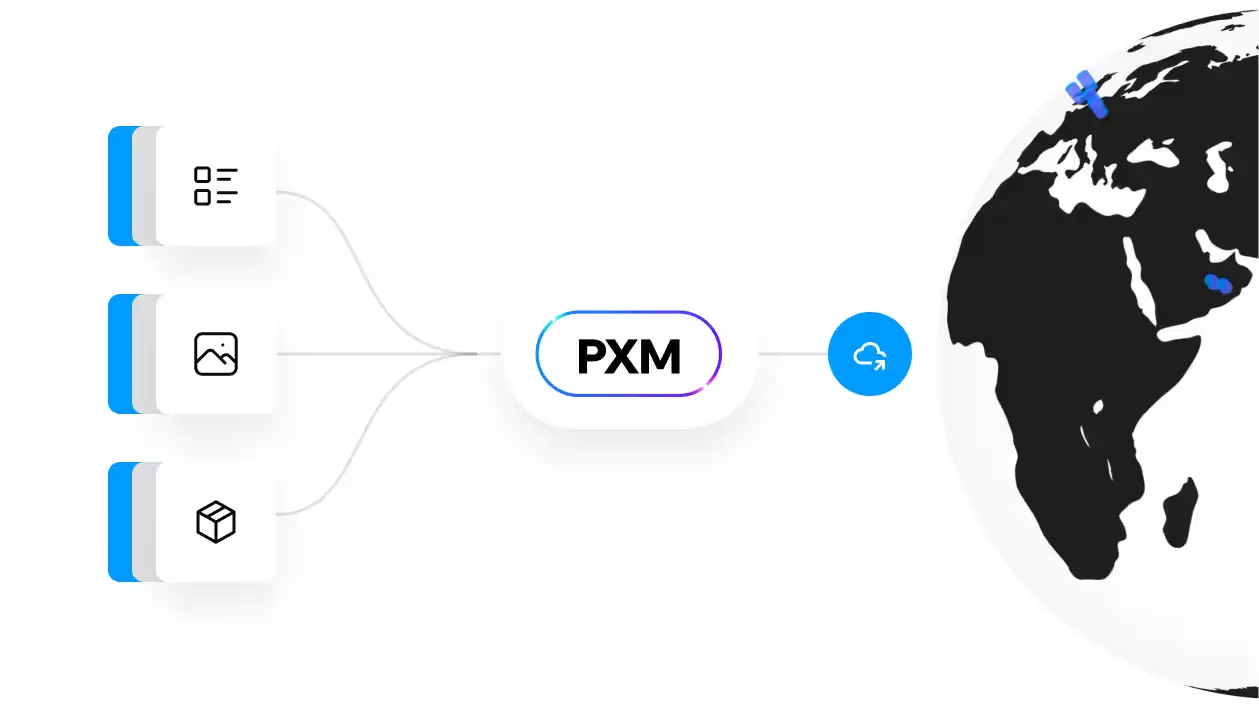
A marketplace listing needs far more product data than an ERP system was built to hold. The ERP knows the SKU, the cost, the weight and the supplier.
The listing needs category-specific attributes, bullet points written for the channel, localised copy for each market, image sets at the right specification, and variation relationships between sizes and colours. None of that lives in an ERP, and pushing ERP fields straight into a channel feed produces thin listings that rank poorly and convert worse.
This is the point where brands usually discover they need a second system rather than a bigger one. The ERP stays the operational record, and a product content layer sits between it and the channels.
Meeting EU product compliance requirements
Product data has become a legal requirement rather than a commercial preference. Under the EU General Product Safety Regulation (Regulation (EU) 2023/988), which has applied since 13 December 2024, listings for consumer products sold into the EU must carry specific information before a shopper buys.
That includes the manufacturer's name and contact details, the details of an EU responsible person where one is required, a product identifier such as a batch or model number, and any safety warnings in the language of the market. Marketplaces themselves are obliged to verify that this information is present and to remove listings that lack it.
Almost all of those fields originate in the ERP or the product data layer beside it. A brand whose systems cannot produce them at SKU level for every market is exposed to delisting, and delisting on a marketplace is immediate.
What Does the Future of ERP Look Like?
Enterprise resource planning is moving from recording what happened to informing what to do next. What began as a production scheduling tool and became a system of record is turning into an analytical layer.
The direction of travel is visible in what organisations are actually deploying. In Panorama Consulting Group's 2026 ERP Report, business intelligence was the most widely deployed digital initiative, with 55.3% of organisations reporting significant deployment.
Cloud deployment will keep displacing on-premise systems, because the flexibility, remote access and simpler upgrade path suit the pace most businesses now work at. Alongside that, artificial intelligence and machine learning are being embedded directly into ERP platforms, shifting them towards predictive insight rather than retrospective reporting.
Two further developments are worth watching. Internet of Things connectivity feeds ERP systems more accurate operational data from physical assets and warehouses, closing the gap between what the system says and what is on the floor.
And as work continues to happen away from a desk, mobile access is becoming a core requirement rather than an add-on, so that the people closest to a decision can act on the data behind it.
How Pattern Helps Brands Grow on Global Marketplaces
An ERP system tells you what is happening in your business. It does not run your marketplace presence for you, and for most brands that gap is where growth stalls.
Pattern closes it. We buy your inventory and take on the execution behind it: advertising, product content, fulfillment, brand control and international expansion, across 70+ marketplaces in more than 100 countries, backed by proprietary technology and 77T+ data points.
Because we buy your stock, we only grow when your brand grows. That alignment shapes every decision we make on your behalf, from which markets to enter to how your listings are built. If you are working out how your systems and your marketplace strategy should fit together, book a strategy call with our team.
Coordinated Systems for Superior Enterprise Resource Planning



Frequently Asked Questions
What is the main function of ERP?
The main function of ERP is to bring company data and workflows into one platform so that every stakeholder works from the same accurate information. That single record improves efficiency and collaboration, strengthens decision-making, and removes the data silos that build up when each department runs its own tool.
What does ERP stand for?
ERP stands for enterprise resource planning. It refers both to the approach of integrating core business processes into one system and to the software category that delivers it.
What is cloud ERP software?
Cloud ERP software is an enterprise resource planning system hosted on remote servers and accessed over the internet on a subscription basis. The provider manages security, maintenance and upgrades, which means a lower internal IT burden and a smaller upfront commitment than an on-premise system.
What are the 3 pillars of an ERP system?
The three pillars of an ERP system are integration, automation and accuracy.
- Integration: The system unifies data and data sources across the business.
- Automation: Routine tasks and handovers run without manual intervention.
- Accuracy: Information stays current and consistent wherever it is used.
What is the difference between ERP and MRP?
MRP plans the materials and components needed for production, while ERP covers that and connects it to finance, procurement, sales and HR. MRP is a component of most manufacturing ERP systems rather than a competing product, so the real question is whether a standalone MRP tool still covers the business.
What is the difference between ERP and CRM?
ERP manages how the business runs internally and CRM manages how it engages customers externally. A CRM holds pipeline, conversation history and service tickets. The ERP holds the resulting order, the stock it consumed and the invoice it produced. Many businesses run both and integrate them.