





August 4, 2026
Ecommerce Marketplace Management: The 8 Core Areas Explained
Ecommerce marketplace management covers the eight areas a brand runs to sell well across Amazon, eBay, Zalando and other marketplaces. Every marketplace sets its own listing rules, advertising system, fees and fulfillment standards, so selling on several at once becomes a large operational load.
.jpg)
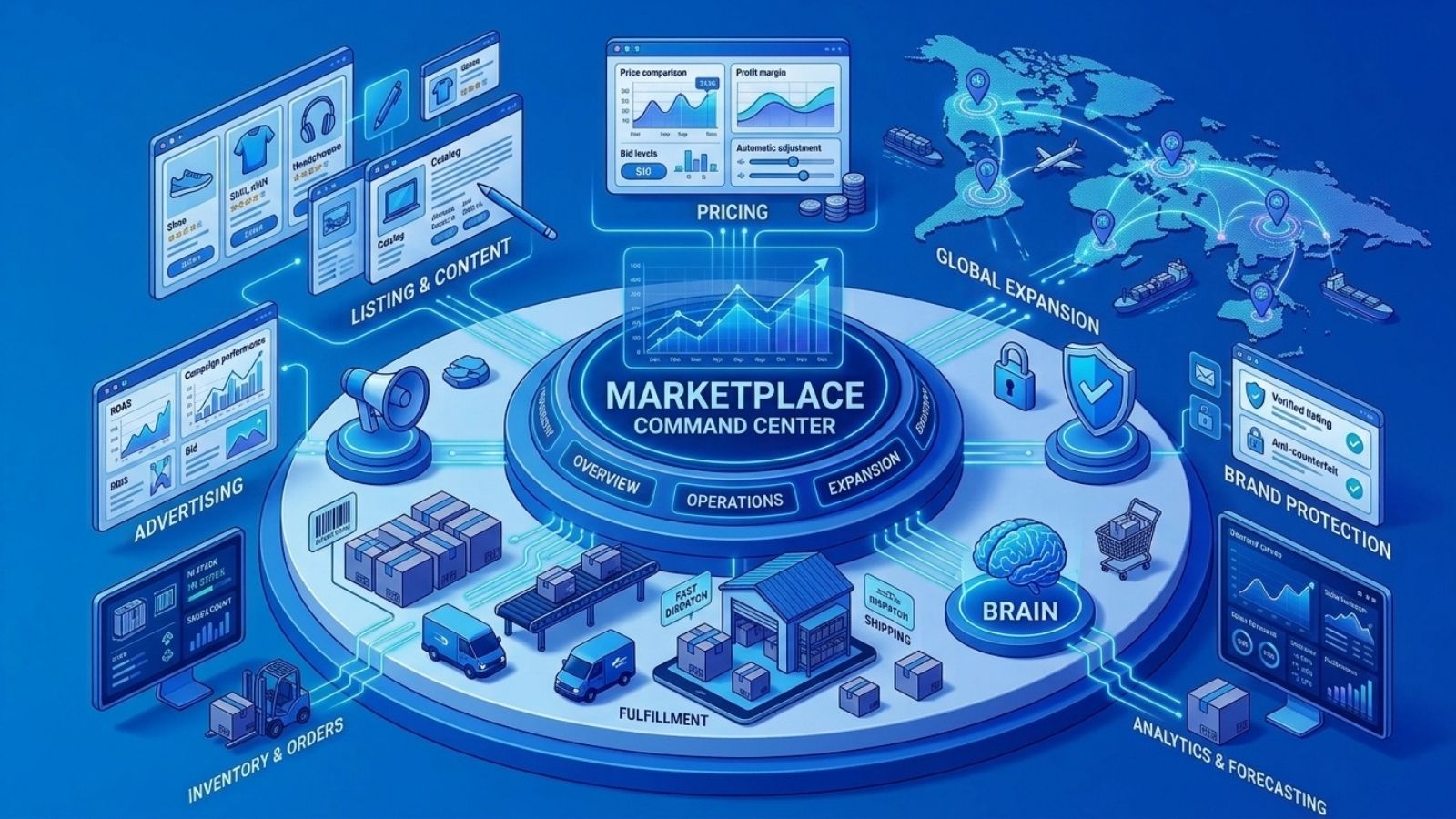
Brands carry that load in three ways: in-house with a dedicated team, through marketplace management software, or by handing execution to a managed marketplace accelerator that runs every channel for them. Eight core areas make up the discipline, and each one is set out below.
What Is Ecommerce Marketplace Management?
Ecommerce marketplace management is the practice of running a brand's listings, pricing, advertising, fulfillment and compliance across third-party marketplaces such as Amazon, eBay, Zalando and TikTok Shop.
The work replaces the merchandising, marketing and logistics of a retail operation, carried out inside each marketplace's own system rather than on a brand's own website. Marketplaces change their algorithms, fees and policies often, so the work is continuous rather than a one-off setup.
The 8 Core Areas of Ecommerce Marketplace Management
The eight core areas of ecommerce marketplace management are listing and content, inventory and orders, fulfillment, advertising, pricing, brand protection, analytics and global expansion.
Together they cover every task between a product going live and revenue landing, across each marketplace and region a brand sells in. Each area is explained below.
1. Listing and Content Management
Listing and content management is the creation and upkeep of every product listing across each marketplace, including titles, descriptions, images, attributes and enhanced or A+ content.
Accurate, well-optimised listings are the foundation of marketplace management, because a marketplace ranks and surfaces products largely on the quality and relevance of their listing data.
A single product often needs a different listing per marketplace, since character limits, image rules and required attributes differ between Amazon, eBay and Zalando.
2. Inventory and Order Management
Inventory and order management keeps stock levels and orders synchronised across every marketplace in real time. Without a single view of stock, a brand oversells on one channel while sitting on excess on another, and marketplace management exists partly to prevent that.
Orders from each marketplace route to the right fulfillment location, and stock counts update everywhere the moment a sale lands, which protects account health and the delivery promise.
3. Fulfillment and Logistics
Fulfillment and logistics covers how orders are picked, packed, shipped and returned once a sale is made. Marketplaces score sellers on delivery speed and accuracy, so fulfillment quality feeds directly into ranking and the Buy Box, tying this area tightly to the rest of marketplace management.
The receiving, storage and picking steps behind it sit within ecommerce warehouse management, the operational layer that decides whether stock turns into on-time deliveries or into stockouts and delays.
4. Marketplace Advertising
Marketplace advertising is the paid promotion that drives visibility inside a marketplace's own search and browse results. Sponsored placements, keyword targeting and bid management lift products up the results a shopper sees, and marketplace management weighs that ad spend against the margin each sale returns.
Advertising and organic ranking reinforce each other on most marketplaces, since a product that sells well through ads tends to rank better organically too.
5. Pricing and Profitability
Pricing and profitability is the ongoing work of setting competitive prices on a brand's own listings while protecting margin. Prices on marketplaces move constantly with demand and competition, so marketplace management adjusts a brand's own prices to stay competitive without eroding profit.
Sound pricing folds fees, advertising cost and fulfillment cost into the final margin, so a higher headline price does not always mean a higher return.
6. Brand Protection and Compliance
Brand protection and compliance keeps a brand's listings accurate, consistent and within each marketplace's policies. Marketplaces suspend accounts and remove listings that breach their rules, so staying compliant protects the sales the other seven areas generate.
The work covers account health, listing accuracy and consistent brand presentation across every channel, so shoppers see the same brand wherever they find it.
7. Analytics and Forecasting
Analytics and forecasting turns marketplace and sales data into decisions about stock, pricing, content and advertising. Every other area of marketplace management improves when it runs on current data rather than guesswork, which is why reporting sits at the centre of the discipline.
Demand forecasting sets how much stock to hold and when to reorder, so a brand meets demand without tying up cash in overstock.
8. Global and Cross-Border Expansion
Global and cross-border expansion is selling the same catalogue into new countries and marketplaces. Growth on a home marketplace eventually caps out, so marketplace management looks outward to marketplaces such as Allegro in Poland, Otto in Germany, noon in the Middle East and TikTok Shop across regions.
Each new market adds localised listings, local tax and VAT handling and a fresh account setup, which is why expansion is treated as its own area rather than a copy of the home market.
Benefits of Ecommerce Marketplace Management
Ecommerce marketplace management gives a brand several concrete advantages once every channel runs as one operation:
- Wider reach, because one operation places a brand's products in front of shoppers on Amazon, eBay, Zalando and dozens of other marketplaces at once.
- Fewer overselling and stockout errors, since inventory and orders stay synchronised across every channel in real time.
- Stronger visibility, as coordinated advertising and well-optimised listings lift a brand's products up each marketplace's search results.
- Protected margin, because pricing, fees and fulfillment costs are managed together rather than in isolation.
- Faster expansion, since listings, tax and account setup follow a repeatable process in each new region.
- Better decisions, as one view of marketplace and sales data replaces guesswork on stock, pricing and content.
Common Challenges in Ecommerce Marketplace Management
Running several marketplaces at once also creates recurring challenges that ecommerce marketplace management exists to solve:
- Fragmented data across channels, which makes accurate stock and pricing hard to maintain without a single system.
- Different rules per marketplace, since listing formats, content requirements and fees vary between Amazon, eBay and Zalando.
- Account health risk, because a policy breach or slow fulfillment can suspend a listing or an entire account.
- Channel conflict, where overlapping listings and inconsistent pricing undercut a brand's own sales.
- Thin internal resource, as running advertising, content, pricing and logistics well demands time and specialist skill.
- Cross-border complexity, since each new country adds localisation, tax and compliance work.
Ecommerce Marketplace Management vs Multichannel Management
Ecommerce marketplace management and multichannel management differ in that marketplace management runs third-party marketplace channels specifically, while multichannel management covers every sales channel a brand uses.
Multichannel includes a brand's own website, physical retail and wholesale alongside marketplaces, so marketplace management is one specialised part of it.
The choice of where to sell in the first place, a brand's own store against third-party marketplaces, is a separate decision covered in ecommerce platform vs marketplace, and it shapes how much marketplace management a brand needs.
Ecommerce Marketplace Management Software vs a Managed Service
Ecommerce marketplace management software and a managed service are not the same, because software gives a brand the tools to do the work, while a managed service does the work for the brand. Software centralises listings, inventory and orders in one dashboard, and an in-house team operates it.
A managed service, sometimes called a marketplace accelerator, supplies both the technology and the people who run advertising, content, pricing and fulfillment day to day.
The right choice depends on whether a brand has the internal expertise and time to run marketplaces itself, or prefers to hand execution to an external team. Brands weighing that decision for Amazon, eBay and other global marketplaces can book a strategy call with Pattern to scope the work.
Frequently Asked Questions
When Should a Brand Outsource Marketplace Management?
A brand outsources marketplace management when its team lacks the time or expertise to run marketplaces well, growth has stalled, or a move into new regions adds more complexity than the team can absorb. Outsourcing hands day-to-day execution to specialists while the brand keeps strategic control.
What Should You Look for in a Marketplace Management Partner?
When choosing a marketplace management partner, evaluate marketplace and region coverage, integrations with your existing systems, how closely their incentives align with your growth, and the depth of their reporting. A partner whose earnings rise only when yours do carries less risk of misaligned priorities.
How Does Marketplace Management Work for Growing Brands?
For growing brands, marketplace management works by standardising listings, connecting inventory across channels and building an advertising and pricing routine that scales as volume rises. The aim is a repeatable system, so adding a marketplace adds revenue rather than chaos.
How Does It Work for Brands Entering New Regions?
For brands entering new regions, marketplace management works by localising listings, handling local tax and VAT, and setting up compliant accounts on the marketplaces that matter in each market. Cross-border demand and shipping rules differ per country, so each region gets its own plan.
How Do You Get Started With Ecommerce Marketplace Management?
To get started with ecommerce marketplace management, map the marketplaces where your brand sells or wants to, audit your listings, pricing and fulfillment, then decide whether to run it in-house, on software, or with a partner. Brands that lack the internal resource to run every marketplace themselves hand execution to specialists and keep strategic control.