





July 10, 2026
Ecommerce warehouse management
Ecommerce warehouse management is the operational engine behind every online order. For a growing brand selling across marketplaces, how well you receive, store, pick, pack and ship your stock decides whether demand turns into revenue or into late deliveries, stockouts and returns.
.jpg)
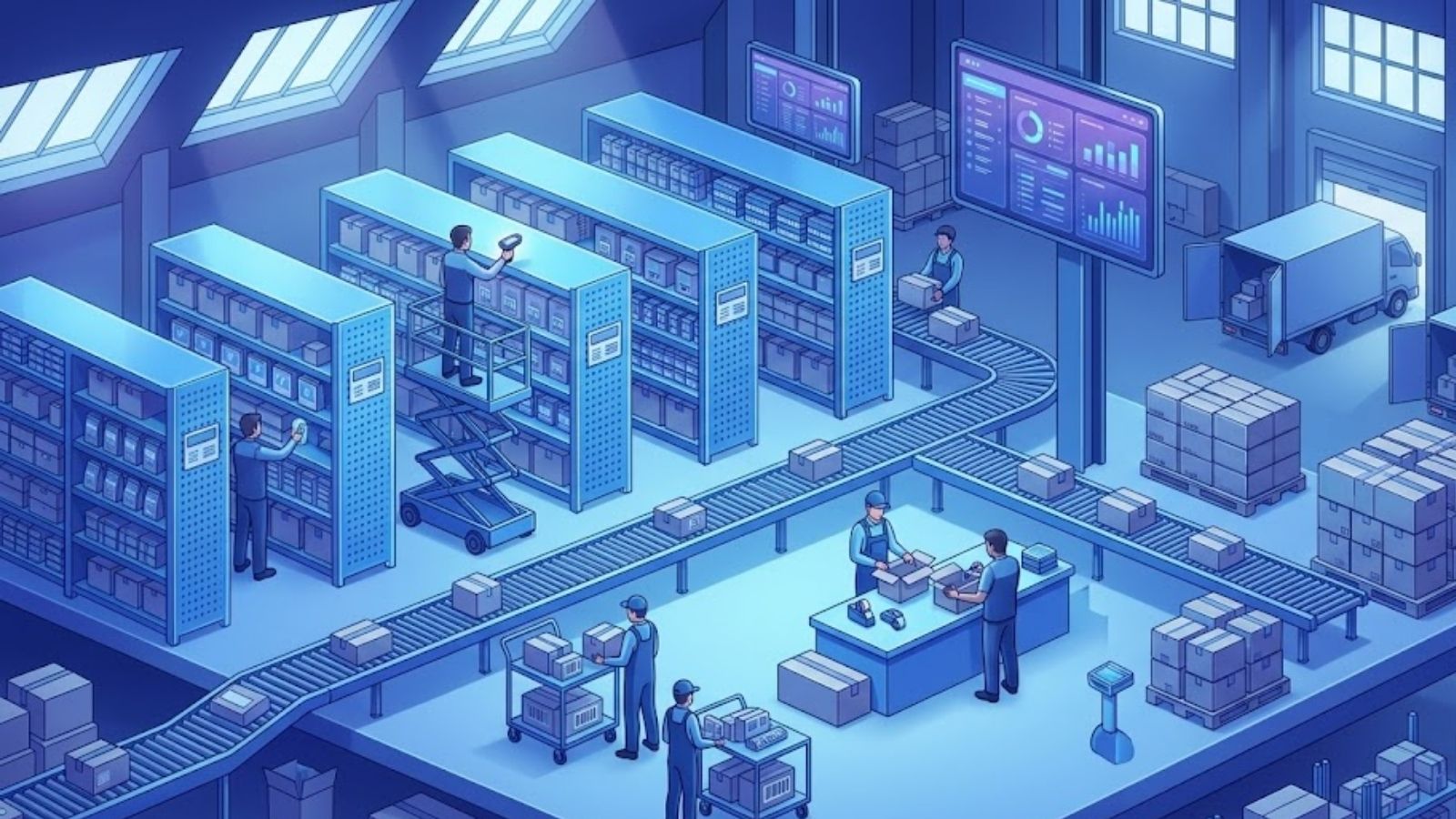
This guide explains what ecommerce warehouse management involves, how a warehouse management system fits in, the best practices that keep an operation efficient, and how to decide whether to run it yourself or hand it to a partner.
What is ecommerce warehouse management?
Ecommerce warehouse management is the coordination of everything that happens to your stock inside a warehouse: receiving inventory, storing it, tracking it, and turning incoming orders into packed parcels ready to ship.
Unlike a traditional storage warehouse, where goods can sit for long periods, an ecommerce warehouse is a high-throughput operation built to process individual orders quickly and accurately, often against same-day or next-day cut-offs.
It helps to separate two terms that are often used interchangeably. A warehouse is primarily about storage, holding stock in bulk. A fulfilment center is an active operation with dedicated zones for picking, packing, labelling, kitting and returns, the kind of fulfilment and logistics setup that turns stock into shipped orders.
Most ecommerce brands need the second, because the value is in how fast and how accurately orders move, not simply in where the stock is kept.
How ecommerce warehouse management works
Behind a smooth delivery promise sits a sequence of steps, each of which can add speed or introduce error. Managed well, they run as one flow rather than a set of disconnected tasks, which is how logistics turns from a cost into a revenue driver.
- Receiving: Checking incoming stock against purchase orders and logging it into the system, the inbound work covered by marketplace prep, so inventory counts are accurate from the first moment.
- Storage and putaway: Assigning each SKU a logical location so it can be found and picked quickly, rather than searched for.
- Inventory management: Keeping a real-time view of stock levels across every channel, so you neither run out nor overstock.
- Picking: Pulling the right items for each order, the step where most time and most errors are concentrated.
- Packing: Preparing orders so they arrive undamaged and on brand, ready for the carrier.
- Shipping: Handing off to the right carrier and passing tracking back to the customer.
- Returns: Processing reverse logistics quickly, so stock can be resold and customers refunded without friction.
What a warehouse management system (WMS) does
A warehouse management system, or WMS, is the software that runs and records all of this. It tells staff where to put stock, guides picking routes, updates inventory in real time as items move, and connects to your sales channels so orders flow in and tracking flows out.
Paired with barcode scanning or RFID, a good WMS is what lets a warehouse reach accuracy levels of 99% or more. It is worth being clear on what a WMS is not. Your ecommerce platform, such as Shopify, or a marketplace such as Amazon, handles selling: the storefront, the listing, the checkout.
A WMS handles what happens after the order is placed. The two integrate, but they solve different problems, and a brand growing across several marketplaces needs both working together.
Best practices for ecommerce warehouse management
Whatever tools you use, a handful of practices separate a warehouse that scales from one that buckles under peak demand.
- Prioritise inventory accuracy: Reliable stock data lets you hold less safety stock while avoiding stockouts, oversells and markdowns.
- Design the layout around movement: Placing fast-moving SKUs near packing stations and mapping efficient picking routes cuts the time spent walking the floor.
- Automate where it pays back: Barcode scanning, RFID and pick-to-light reduce manual error, and heavier automation earns its place once volume is high enough.
- Forecast demand: Using sales data and AI inventory forecasting to predict order volume keeps stock and labour matched to what is actually coming.
- Build returns into the process: Treating reverse logistics as a core workflow rather than an afterthought protects both margin and customer experience.
- Track the right metrics: Order accuracy, on-time dispatch, picking productivity and inventory turnover show where an operation is winning or slipping.
In-house warehouse vs outsourced fulfilment
Once volume grows, the real question is who runs all of this. Broadly there are three routes: run your own warehouse and WMS, hand storage and shipping to a standalone 3PL, or partner with an accelerator that folds fulfilment into your whole marketplace operation. They differ in cost, control and how much of the work stays on your plate.
Running your own warehouse and WMS
Running your own warehouse gives you the most direct control over how orders are handled. It also carries the most fixed cost and complexity. You own the space, the staff, the equipment and the WMS, and you carry the burden of keeping each marketplace compliant with its own labelling and prep rules.
For brands with the volume to justify it, this can work; for most, the overhead grows faster than the benefit as new channels and regions are added.
Using a standalone 3PL
A third-party logistics provider takes storage, picking, packing and shipping off your hands, usually at a variable cost that flexes with volume. It removes a lot of operational weight. The limit is that a standalone 3PL handles the parcel, not the marketplace: listings, advertising, account health and content still sit with you or with separate providers.
That can leave you coordinating a patchwork, which is often why brands revisit the make-or-buy decision behind ecommerce outsourcing once they are selling across several channels.
Partnering for integrated fulfilment
An accelerator folds fulfilment into the wider job of selling. Instead of managing a warehouse, a WMS and a marketplace strategy as separate problems, you get one partner running the full operational scope of managed ecommerce, with warehousing and shipping built into it.
The advantage over a standalone 3PL is that the same team responsible for getting the parcel out is also responsible for the listing, the advertising and the account health behind it, so nothing falls between suppliers.
How Pattern handles warehouse management and fulfilment
Pattern runs fulfilment and logistics as one layer inside full marketplace execution, rather than as a service you have to bolt on. Our Marketplace Prep, DTC shipping and cross-border distribution cover receiving, storage, picking, packing and returns, with Amazon-compliant labelling and our own warehouse software handling the detail.
Our data shows a 75% faster turnaround from receiving to inbound marketplaces and a 99.9% accuracy rate in prep, labelling and tracking.
What sits underneath it is the 3P model. On day one we buy your inventory and sell it as our own, which means the warehouse, the WMS and the marketplace strategy are all run by one team whose incentives are tied to your growth.
You do not choose, integrate or maintain a warehouse system, and you do not coordinate a separate 3PL against separate marketplace providers. It all runs through our 3P Marketplace Accelerator, across 70+ marketplaces and 100+ countries, with local teams in 16 locations.
If warehouse and fulfilment complexity is slowing your growth across marketplaces, this is worth a conversation. Book a strategy call to see how Pattern could take the operation off your plate.
Frequently Asked Questions
What is the difference between a warehouse and a fulfilment center?
A warehouse is primarily a storage facility, where stock is held in bulk for longer periods with little activity beyond receiving and dispatch. A fulfilment center is an active operation built to process individual online orders, with dedicated zones for picking, packing, labelling and returns. Most ecommerce brands rely on the second, because speed and accuracy matter more than storage alone.
What does a warehouse management system do?
A warehouse management system, or WMS, is software that controls and records warehouse operations. It directs where stock is placed, guides picking, updates inventory in real time and connects to your sales channels so orders and tracking flow automatically. The result is fewer errors, faster fulfilment and reliable stock data across every channel.
Do I need a WMS for my ecommerce business?
Most growing ecommerce brands benefit from a WMS once order volume and SKU count rise beyond what manual processes can handle accurately. If you are seeing picking errors, stock discrepancies or slow dispatch, a WMS usually pays for itself. Brands that outsource fulfilment to a partner get this capability built in, without buying or maintaining the software themselves.
Should I outsource ecommerce warehouse management?
Outsourcing makes sense when the operational load of running a warehouse is holding back the rest of the business, or when you are expanding into channels and regions faster than you can staff. A standalone 3PL handles storage and shipping, while a full-service partner also runs the marketplace side, so warehouse management, listings and advertising are managed as one operation rather than separate contracts.