





August 8, 2026
Ecommerce packaging: types and sustainable options
Ecommerce packaging is the layer between your product and the customer who ordered it, and it decides whether that order arrives intact, on budget and looking like it came from your brand. It covers the box or mailer your order ships in, the material that protects the product inside, and the labels and tape that hold everything together.
.jpg)
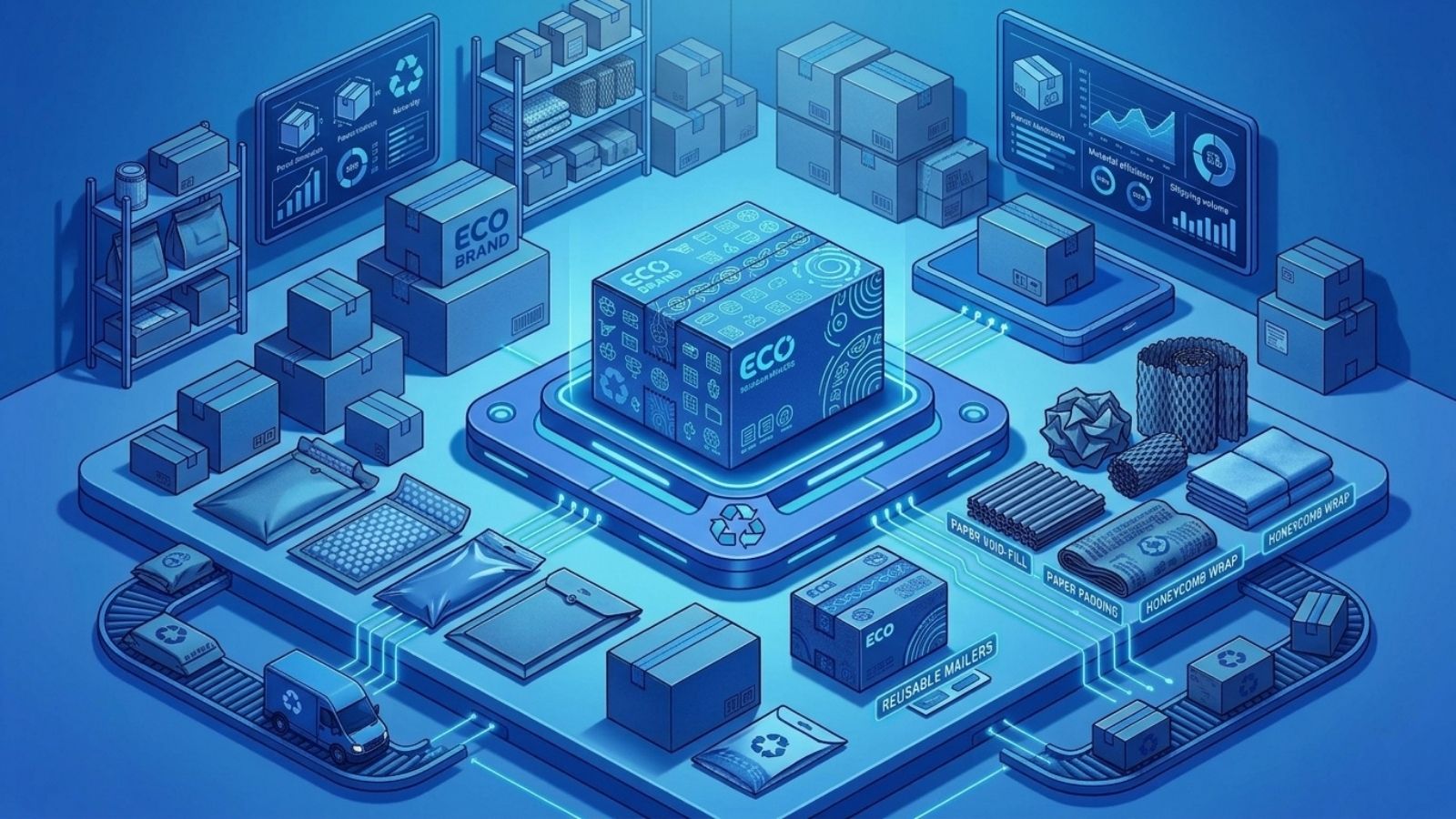
Get it right and packaging does three jobs at once. It protects goods in transit, it carries the first physical impression a customer ever has of your brand, and it sets the cost and weight profile of every parcel you send. Get it wrong and you pay for it twice, once in damaged stock and returns, and again in the impression the customer is left with.
The formats themselves are straightforward: corrugated boxes, mailers and envelopes, void fill, and the reusable systems that are slowly gaining ground. Choosing between them is less straightforward, because the right answer depends on what you sell, how fragile it is, how much it weighs and where it is going.
Sustainability sits over the whole decision. UK shoppers increasingly expect recyclable or reusable packaging, and UK regulation now puts the cost of packaging waste on the businesses that place it on the market. That changes the maths on materials in a way it did not five years ago.
And as volumes grow, packaging stops being a purchasing decision and becomes an operational one, spanning right-sizing, automation, multiple marketplaces and multiple countries. This guide works through each of those stages in turn.
What is ecommerce packaging?
Ecommerce packaging is the set of materials used to contain, protect and ship an online order from the warehouse to the customer's door. It differs from traditional retail packaging in one important way: nothing sits on a shelf competing for attention, so the packaging is judged on how well it survives the journey and how it feels to open.
In practice, packaging is described in three layers. Most brands use all three, though a small parcel may collapse two of them into one.
1. Primary packaging
Primary packaging is the layer in direct contact with the product itself. It is the bottle that holds the serum, the pouch that holds the coffee, the printed carton around a boxed device.
Its first job is to contain and preserve the product, and its second is to carry the product information, branding and any regulatory labelling the category requires. In an ecommerce context, primary packaging also has to survive being handled far more roughly than it would be in a shop.
2. Secondary packaging
Secondary packaging is the shipping layer: the corrugated box or mailer that the order actually travels in, along with whatever protects the product inside it.
This is the layer most people mean when they say ecommerce packaging, and it is where most of the cost, weight and branding decisions are made. Because it is the layer the customer opens, it does double duty as protection and as presentation.
3. Tertiary and transit packaging
Tertiary packaging is the outermost layer used to move goods in bulk rather than one order at a time. Pallets, stretch wrap, shipper cases and the master cartons that carry many units into a fulfillment centre all belong here.
Customers rarely see it, but it governs whether stock arrives at the warehouse or the marketplace in a condition that can be sold, and marketplaces often have their own specifications for it.
Why does ecommerce packaging matter for your brand?
Ecommerce packaging matters because it is the only physical contact most online brands have with their customers, and because it quietly sets the cost of every order you ship. In a shop, the store does the work of making an impression. Online, the parcel does.
The business case breaks down into a handful of effects that compound as volume grows:
- Protection in transit: Damaged goods create refunds, replacement shipping and support tickets, and the returned unit is often unsellable.
- First impression: The parcel is the first tangible thing a new customer holds, and it sets expectations for the product inside it.
- Repeat purchase: In Macfarlane Packaging's 2024 UK unboxing survey, 56% of shoppers said branded packaging would encourage them to buy again, while only 58% of parcels arrived branded.
- Sustainability expectations: The same survey found 76% of UK consumers now expect online deliveries to be sustainably packaged as standard.
- Shipping cost: Size and weight determine the rate you pay, so packaging choices feed straight into margin on every order.
None of these are marketing abstractions. Each one shows up either in your returns rate or in your cost per parcel.
What types of ecommerce packaging are there?
Ecommerce packaging comes in four broad families, and most brands end up using a combination rather than picking one. The outer format carries the order, the inner materials protect it, and the choice between them is driven by the product rather than by preference.
- Boxes: Corrugated shipping boxes and folding cartons, for bulkier, heavier or multi-item orders.
- Mailers, envelopes and bags: Flexible or semi-rigid formats for smaller, flatter and less fragile goods.
- Void fill and protective materials: Everything that sits between the product and the walls of the outer pack.
- Circular and reusable systems: Formats designed to come back and be used again rather than be discarded.
Corrugated boxes
Corrugated boxes are the default format for ecommerce, and they carry the largest share of UK consumer parcels. The fluted construction gives strength relative to weight, they stack and palletise cleanly, they take print well, and shoppers know how to recycle them.
Single wall handles most orders; double wall is worth the extra material for heavy, high value or awkwardly shaped goods. The main drawbacks are weight compared with a mailer, the air you ship if the box is not right-sized, and the assembly time at the pack bench.
Mailers, envelopes and bags
Mailers, envelopes and bags are the lighter alternative for products that do not need a rigid shell. They take up less storage space, add less weight to the parcel and are quicker to pack, which is why apparel and small goods brands lean on them heavily.
Pack speed stops being a detail once someone else is picking your orders, because the format you choose sets the handling time in every direct-to-consumer fulfillment operation that ships them. The category splits into a few recognisable formats:
- Poly mailers: Lightweight and water resistant, well suited to soft goods such as clothing and textiles.
- Paper and kraft mailers: A paper based alternative that holds its shape and is easy for customers to recycle.
- Padded and bubble mailers: A cushioned lining for small items that need some impact protection.
- Rigid mailers: Stiff board formats that stop flat items such as prints and documents from bending.
- Mailing bags for bulk: Larger sacks used where several soft items travel together.
Void fill and protective packaging
Void fill is the material that stops a product moving inside its outer pack, and it is where most damage problems are actually solved. Options include tissue paper, kraft packing paper, honeycomb and expanded paper wraps, air pillows, corrugated pads and moulded inserts.
The choice is a trade off between protection, weight, cost and how easily the customer can dispose of it. The best result usually comes from reducing the void in the first place, because a correctly sized outer pack needs far less filling.
Circular and reusable packaging
Circular packaging is designed to be returned and reused rather than recycled or binned, closing the loop between retailer and customer. Reusable mailers and returnable transit packaging are the most common forms.
The appeal is obvious, but the operational reality is harder: the system only works if returning the pack is genuinely easy for the customer and economical for the retailer at scale. Macfarlane Packaging's 2024 unboxing survey found 89% of UK shoppers were willing to return packaging for reuse, but 61% only if the retailer covered the cost of the return.
How can custom ecommerce packaging strengthen your brand?
Custom ecommerce packaging strengthens your brand by turning a purely functional parcel into a branded moment, without changing anything about the product inside. The parcel is already being delivered and already being opened, so the surface is free; the only question is whether you use it.
Customisation runs on a spectrum from cheap and quick to fully bespoke, and it is worth knowing where the low effort wins sit:
- Branded tape and stickers: The lowest cost route to a branded parcel, applied to plain stock packaging.
- Custom printed boxes and mailers: Full colour outer packaging in your brand's design, usually at higher minimum order quantities.
- Printed tissue and inner wrap: Adds a second reveal inside the outer pack and cushions the product at the same time.
- Packaging inserts: Cards, care instructions, samples or discount codes that give the customer a reason to keep engaging.
- Custom sizing: Packaging cut to the product rather than the product squeezed into stock sizes, which improves both presentation and protection.
One caution: customisation should not undo your material choices. A heavily laminated or foiled box looks premium and recycles badly, and customers increasingly notice the difference.
How do you choose the right ecommerce packaging for your products?
You choose the right ecommerce packaging by starting from the product and the journey rather than from the format. A glass bottle travelling across a border and a cotton t-shirt going across a city have almost nothing in common, and no single pack type serves both well.
Work through these factors before you commit to a format or place a first order:
- Size and shape: Awkward or oversized products narrow the options quickly and often push you towards custom sizing.
- Weight: Heavier goods need rigid outer packs, and the pack's own weight is added to every shipping rate you pay.
- Fragility: Anything breakable needs both a rigid outer and a considered inner protection layer.
- Value: High value goods justify more protection and more discreet outer packaging to reduce theft risk.
- Right-sizing: Match the pack to the product so you are not paying to ship air or filling voids unnecessarily.
- Volumetric weight: Carriers charge on size as well as actual weight, so an oversized box costs more even when it is light.
- Sustainability goals: Decide early whether recyclability, recycled content or reusability is the priority, because it constrains the material set.
- Testing: Order samples and ship real orders to yourself before committing to volume.
Who sets these requirements depends on how you sell. Selling wholesale into a retailer hands much of the packaging specification to them, while selling as a third-party seller leaves it with you, a split we cover in our guide to the Amazon 1P and 3P models.
How do you source ecommerce packaging supplies?
You can source ecommerce packaging supplies through four main routes, and most growing brands move between them as their volumes change. The right route depends less on price than on order quantity, lead time and how much customisation you need.
- Packaging resellers and retailers: Stock formats in small quantities with short lead times, ideal while you are still testing.
- Online packaging marketplaces: Web based suppliers offering custom print at moderate quantities, often with design tools built in.
- Direct from the manufacturer: The best route for bespoke sizes and full customisation, though minimum order quantities are higher.
- Third party logistics providers: Many 3PL and fulfillment partners supply packaging as part of the service, removing a separate supplier relationship.
That last route changes the question from what to buy to who runs the operation, which is the same make-or-buy decision we set out in our guide to ecommerce outsourcing.
Two things are worth checking whichever route you take. First, lead times, because packaging shortages stop shipments in a way few other shortages do. Second, whether the supplier can grow with you, since switching supplier at the point your volumes spike is a difficult time to change anything.
How do you choose sustainable ecommerce packaging?
Sustainable ecommerce packaging means choosing materials and formats that reduce environmental impact across their whole life, from what they are made of to what happens after the customer opens the parcel. It is rarely a single clean choice, because the most recyclable option is not always the lightest, and the lightest is not always the easiest to dispose of.
Recyclable, compostable and reusable materials
Most sustainable packaging decisions come down to which end of life route you are designing for. Recyclable materials go back into the material stream, compostable ones break down, and reusable ones stay in circulation. Each has different implications for cost and for what you ask the customer to do.
- Recycled content board and paper: Widely recyclable through kerbside collections and familiar to customers.
- Compostable mailers: Break down under the right conditions, though those conditions are not always available to the customer.
- Reusable mailers and transit packaging: Lowest impact per use, but only if the return loop actually works.
- Certified sourcing: Certification such as FSC gives customers a recognisable signal about where the fibre came from.
- Less material overall: Right-sizing and removing unnecessary layers reduce impact and cost at the same time.
Paper versus plastic
The paper versus plastic choice comes down to a genuine trade off rather than a clear winner. Paper and board are made from renewable fibre, are widely recycled in the UK, and are what most customers instinctively read as the sustainable option.
Recycled plastic mailers are lighter, which lowers transport emissions and shipping cost, and they resist weather in a way paper does not. The weakness of plastic is end of life: flexible plastics remain difficult to recycle through household collections, so much of it is not recovered. The honest answer is that the better option depends on what you ship and on which impact you are prioritising.
UK packaging regulations to be aware of
UK online sellers should be aware that packaging is now a regulated cost as well as a design decision. Packaging Extended Producer Responsibility shifts the cost of managing household packaging waste onto the businesses that place that packaging on the market.
Under the Producer Responsibility Obligations (Packaging and Packaging Waste) Regulations 2024, the obligated producer classes include brand owners, packers and fillers, importers, distributors, sellers and online marketplace operators, so the same parcel can sit with a different party depending on how it reached the customer.
GOV.UK sets the entry point at an annual turnover of £1 million or more combined with responsibility for more than 25 tonnes of packaging in the previous calendar year, alongside carrying out a covered packaging activity. Fees started as flat base rates per tonne of material and move to rates adjusted for how recyclable that material is, which is what makes material choice a direct cost question.
The separate Plastic Packaging Tax applies to plastic packaging that falls below a recycled content threshold. Thresholds, fees and deadlines change, so confirm your own position on GOV.UK or with a compliance scheme. This is context for your material choices, not legal advice.
How do you scale and automate ecommerce packaging as your brand grows?
You scale ecommerce packaging by treating it as an operating system rather than a purchase order. At low volume, packaging is a supplier and a stock cupboard. At high volume, it is a set of decisions about pack sizes, bench processes, carrier rates, marketplace requirements and regulatory reporting, all of which multiply as you add channels and countries.
Right-sizing and packaging automation
Right-sizing and packaging automation work by removing the gap between the product and the pack, and then removing the manual work of closing it. The same discipline applies upstream, where marketplace prep turns a marketplace's labelling and packing rules into a repeatable process rather than a per-shipment scramble.
Instead of forcing every order into a handful of stock box sizes, automated systems produce or select a pack that fits the order, which cuts material use, reduces void fill and lowers the volumetric weight you are charged for.
- Fewer wasted materials: A pack sized to the order needs less board and far less void fill.
- Lower shipping cost: Smaller parcels reduce volumetric weight charges and fit more units per vehicle.
- Faster pack benches: Automation takes the assembly and decision time out of each order.
- Consistency: Every order is packed the same way, which makes damage rates measurable rather than anecdotal.
Packaging across marketplaces and borders
Packaging across marketplaces and borders means meeting several sets of requirements at once with one operation. Marketplaces set their own prep, labelling and packaging specifications, and non compliant stock is rejected at the point it is least convenient.
Cross border shipping adds longer journeys, more handling and different recycling infrastructure at destination, all of which affect what packaging will actually survive and what customers can do with it afterwards.
Every additional platform you add multiplies those specifications, which is why packaging decisions and selling across global marketplaces are rarely separable, and why global expansion tends to expose packaging problems before it exposes demand problems.
UK packaging obligations add a further wrinkle for marketplace models, because an online marketplace operator is treated as the producer for packaging that non-UK sellers place on the UK market, while UK-established sellers continue to report their own. The brands that handle this well standardise where they can and localise only where the rules force them to.
When should you outsource ecommerce packaging and fulfillment to a partner?
You should consider outsourcing ecommerce packaging and fulfillment when the operation costs more in attention than it returns in control, typically when order volumes, marketplace requirements or the number of countries you ship to outgrow the team you have. If your volumes are steady and single market, keeping it in house is often the better answer.
The tipping point is usually not volume alone. It is the moment packaging stops being a materials choice and becomes an operational system spanning marketplace prep, carrier selection, cross border shipping and compliance reporting, which is the layer a marketplace accelerator such as Pattern runs through its fulfillment and logistics offering.
Before making that call, it is worth being honest about which parts of the problem you actually want to own: brands that outsource for cost alone are often disappointed, while brands that outsource because the operational complexity has outgrown them usually are not. The criteria for judging that are the same ones we apply to choosing any ecommerce partner.
How Pattern takes the packaging and fulfillment load off your team
Pattern is an ecommerce marketplace accelerator that runs the commercial and operational side of selling for global brands. Packaging sits inside that remit rather than beside it, because the pack you choose determines the prep, the shipping rate and the compliance position on every order that follows it.
We buy your inventory and then run the channel end to end, so marketplace prep, warehousing, shipping and direct-to-consumer delivery are handled by one partner rather than coordinated across several.
That matters most when you are packing to different specifications for different marketplaces in different countries at the same time, which is where in-house operations usually start to strain. You can see how this works in practice through the 3P marketplace accelerator.
Book a strategy call to see how Pattern can take the operational weight of packaging and fulfillment off your team.
Frequently Asked Questions
What is the best packaging for ecommerce?
The best ecommerce packaging is the one that protects your specific product at the lowest weight and cost, while being easy for your customer to open and dispose of. For most brands that means corrugated boxes for bulky or fragile goods and mailers for soft, flat items. There is no universally best format, and any supplier who offers one is describing their catalogue rather than your problem. The useful question is which format wins for each product line you ship, which is why many brands run two or three formats side by side.
What is the difference between a mailer and a box?
A mailer is a flexible or semi-rigid pack that wraps close to the product, while a box is a rigid corrugated pack that holds its own shape. Mailers are lighter, cheaper to ship and quicker to pack. Boxes offer more protection and better presentation. The dividing line in practice is fragility and shape. If the product can bend, compress or flex without harm, a mailer is usually the more efficient choice. If it cannot, or if several items travel together, a box earns its extra weight.
What is sustainable ecommerce packaging?
Sustainable ecommerce packaging is packaging designed to reduce environmental impact across its life cycle, typically by using recycled or renewable materials, being recyclable, compostable or reusable, and using as little material as the product allows. The definition matters because the label is applied loosely. A pack made from recycled content but impossible to recycle afterwards is only half of the picture, and so is a compostable pack that no local facility will accept.
How can you reduce ecommerce packaging costs?
You can reduce ecommerce packaging costs by right-sizing packs to the product, cutting parcel weight and volume, standardising on fewer formats, and reducing damage rates so you are not paying to ship the same order twice. The largest savings usually sit in volumetric weight rather than in the unit price of the packaging itself. A cheaper box that ships air costs more in total than a better fitting one, and damage and returns tend to dwarf both.
What ecommerce packaging is right for a small business?
For a small business, the right ecommerce packaging is stock formats bought in small quantities from a reseller, customised cheaply with branded tape or stickers rather than bespoke print. This keeps working capital out of packaging stock while you are still learning what you ship most and where damage actually occurs. Custom print becomes worthwhile once your volumes and your product range have both settled.
What ecommerce packaging is right for an enterprise brand?
For an enterprise brand, the right ecommerce packaging is a standardised set of right-sized formats supported by pack automation, consistent across every marketplace and market you sell in, with material choices that satisfy reporting obligations. At this scale the packaging decision is inseparable from the fulfillment operation. Small per parcel differences in weight, material or pack time become significant numbers once they are multiplied across every order, which is the point at which managed ecommerce becomes a live option rather than a theoretical one.