





.jpg)

For brands looking to sell on Amazon, choosing the right selling model is crucial. You could opt for a first-party (1P model), where Amazon buys your products wholesale and fulfills orders on your behalf. You could also choose a third-party (3P selling model), where you sell independently on Amazon marketplace and handle the logistics yourself. That’s just the beginning; there are a handful of other options for brands, each with its own benefits and considerations.
Whether you’ve been selling your products on Amazon for years or you’re just starting out, you’ve probably wondered if 1P or 3P is the best selling model for your brand. As the top ecommerce acceleration platform and 3P seller with deep experience on Amazon, we know there’s no “best way” to sell on Amazon—it depends on your products, long-term goals, and strategy. We’ll dive deeper on your options and the benefits of each selling model.
- What is Amazon 1P vs 3P?
- 1P pros and cons
- 3P pros and cons
- How do I become an Amazon 3P seller?
- 3P partners and other selling model strategies
What is Amazon 1P vs 3P?
In a 1P (or first-party) relationship, Amazon buys your product wholesale and handles most of the selling details. This makes you an Amazon vendor, and you’ll manage your selling in the Vendor Central portal. Amazon takes care of logistics, fulfillment, customer service, and even returns. Essentially, they act as a large online retailer for your brand.
In a 3P (or third-party) relationship, you’re an independent seller on Amazon’s marketplace, which gives you both more control over your brand and more responsibility for logistics. You’ll manage your Amazon account in the Seller Central portal, and you’re responsible for all your marketing, content, and optimization. Depending on how much product you’re selling, you may opt for an Amazon Professional Seller plan, which gives you more control over your Amazon storefront for a monthly fee.
Deciding between 1P and 3P requires weighing the various pros and cons for your business. Brands should consider several factors when choosing an Amazon selling strategy.
Why Amazon is pushing brands from 1P to 3P
Amazon has been reshaping its vendor programme, ending 1P (Vendor Central) relationships with many smaller brands and steering them towards the 3P (Seller Central) model instead. For a lot of brands the choice between Amazon 1P vs 3P is no longer fully theirs to make.
This shift matters because it changes the starting point of the decision. If a 1P invitation is withdrawn, or never offered, 3P becomes the route to keep selling on Amazon while holding on to control of your listings, content and inventory. Understanding both models still matters, because it shapes how well you run 3P once you are there.
Amazon 1P pros and cons
Selling 1P on Amazon means Amazon buys your stock and sells it as the retailer, which brings simplicity but takes control out of your hands. Here are the main benefits and challenges of the Amazon 1P model for your brand.
The benefits of selling 1P on Amazon:
- Amazon is a well-trusted seller—consumers may trust your brand more if your products are sold and fulfilled by Amazon
- As a 1P seller, your products are automatically eligible for Amazon Prime and two-day shipping
- Amazon handles all the logistics for 1P selling: taxes, assigning and tracking Amazon Standard Identification Numbers (ASINs), content and marketing optimisation, and customer service
- 1P Amazon sellers get exclusive benefits, such as placement priority and advanced analytics tools
- Selling your products through Amazon 1P could be the most price efficient option for your brand
- You're basically free of inventory risk and possible listing disciplinary measures
The challenges of selling 1P on Amazon:
- You may lose profit margins to Amazon with a 1P relationship. (Learn the true costs of Amazon 1P)
- Amazon pays for your product wholesale, which may affect revenue and profitability
- You will have little control over availability of inventory on Amazon at any given time
Amazon 3P pros and cons
Selling 3P on Amazon means you or a partner sell directly to shoppers while keeping control of listings, content and inventory. Here are the main benefits and challenges of the Amazon 3P model to weigh up.
The benefits of selling 3P on Amazon:
- Gives you more flexibility and control in every aspect of the selling process, from marketing and content to pricing and customer service
- Strengthens your brand presence
- You have access to all your advertising, selling, and performance data
- Offers complete control over how much inventory you list
- You can share inventory across marketplaces when necessary
- You have creative control over your Amazon storefront
- You have the power to optimise your content, imagery, and listings to drive conversions
The challenges of selling 3P on Amazon:
- You have to handle ad strategy, listing optimisation, and all aspects of your Amazon storefront
- You're responsible for creating purchase orders and handling inventory logistics
- You're responsible for your own customer service
- Brands are required to pay additional fees to Amazon for being a 3P seller
- Your brand can be subject to account suspension, listings being taken down, and other unexpected changes from Amazon
Selling on Amazon in a 3P relationship is an increasingly popular option for brands, and it’s easy to see why. Even though becoming a 3P seller may seem like more work up front, it ultimately gives you more flexibility and control, a stronger brand presence, and better data access.
In a 3P marketplace model, the brand keeps control of listings, content and inventory across Amazon and other channels, which is why many brands treat 3P ecommerce as the route to protecting brand equity at scale.
How to choose between Amazon 1P and 3P
There is no single right answer to Amazon 1P vs 3P; the better model depends on how much control you want and how much of the operation you can carry. A few questions make the choice clearer.
- Control: Do you need to own your listings, content and pricing, or are you comfortable handing that to Amazon? 3P keeps control with you, 1P hands it to Amazon.
- Operational capacity: Can your team run advertising, content and inventory across the marketplace, or would you rather Amazon handled the logistics? 3P asks more of you, unless you appoint a partner.
- Cash flow: 1P vendors are paid on Amazon's terms, while 3P sellers collect faster; the difference matters for working capital.
- Brand protection: If a consistent, protected brand presence is a priority, 3P gives you the levers to manage it directly.
Most brands revisit this decision as they grow, and many move from 1P to 3P once control and margin outweigh the simplicity of letting Amazon sell.
How to become an Amazon 3P seller
You can only become a 1P seller through a direct invitation from Amazon. To become a 3P seller, the first step is setting up a Seller Central account. You’ll then provide relevant information and verifications before getting your account approved and finally listing and shipping your products.
When it comes to shipping your products as a 3P seller on Amazon, you have two options: Fulfilment by Merchant (FBM) or Fulfilment by Amazon (FBA). If you choose FBM, you are responsible for maintaining inventory, monitoring in-stock rates, labelling, packaging, and shipping your products to each customer. If you choose FBA, your inventory is stored in Amazon’s fulfilment centers—you don’t need to worry about packaging and shipping. However, if you do choose FBA, you’ll need to comply with Amazon’s prep requirements and pay inbound placement fees.
3P partners and other selling model strategies
While deciding between a 1P or 3P relationship is a solid start, Amazon sellers should know about a few other selling models and strategies. While 1P and 3P are the most common, many brands tap into these other options:
- 3P Unmanaged: no active management of your brand
- 2P: Fulfilled by Amazon (FBA) model
- Hybrid: leverages both 1P and 3P strategies
- 3P Network: you create a network of authorised sellers
- 3P Partner: you partner with one exclusive ecommerce seller

Some brands run a hybrid 1P and 3P setup, selling part of the catalogue wholesale to Amazon while managing the rest as a third-party seller. You may also see the term 2P, a middle model where you list products yourself but use Amazon's fulfilment. Which mix works depends on your margins, your catalogue and how much of the operation you want to run.
Pattern’s 3P ecommerce acceleration platform
In our experience, the ecommerce executives benefit most from a 3P partner model because it provides the most freedom and marketplace control on Amazon, without having to worry about complex logistics. Pattern executes a 3P exclusive seller model because it gives our partners the freedom and control unavailable through a 1P relationship while also taking on the stock, management, and risks that make 3P selling intimidating.
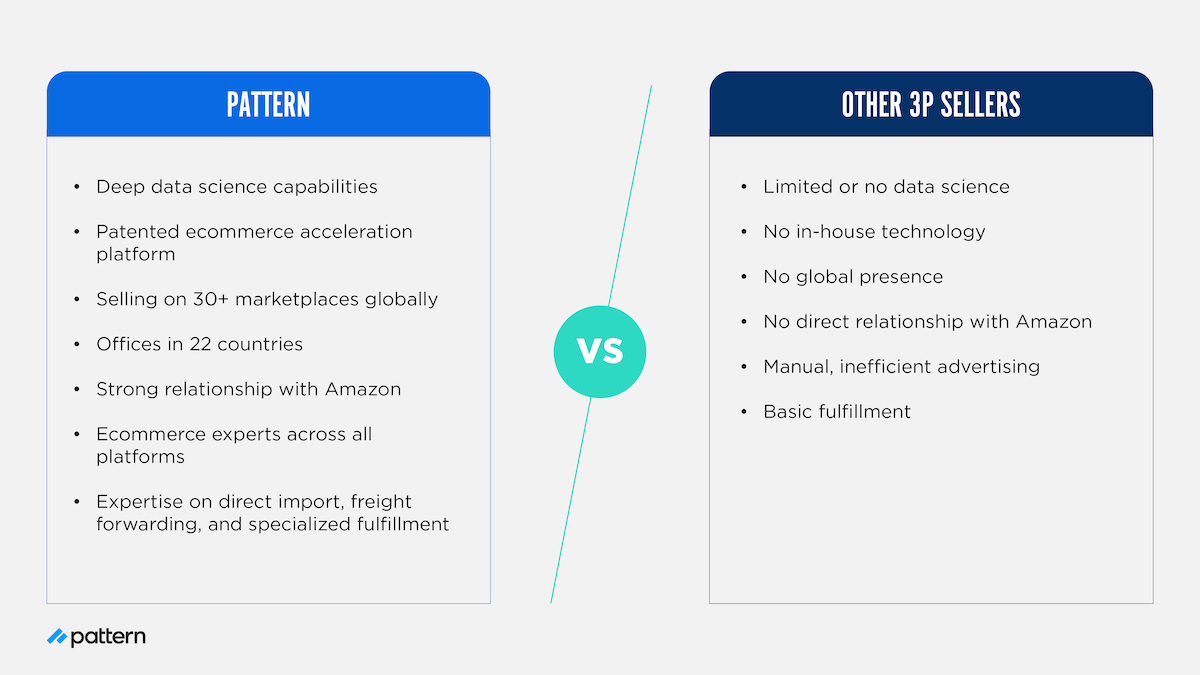
Pattern buys your inventory, preps it for Amazon, manages your marketing and advertising, and sells your products on Amazon as an authorized seller. Once we buy your product, we help you optimise your content and advertising while maximising your brand protection and global strategy development. Our sophisticated inventory forecasting, fulfilment, and logistics systems help us predict and manage your inventory, and our experienced teams handle everything from taxes to customer service.
Unlike a 1P Amazon seller relationship, Pattern’s 3P partner relationship involves your brand every step of the way, including when it comes to branding, 3P content, promotion, channel strategy, and new product launches. We respect your brand by following all product pricing guidelines and committing to never drop below MAP policies.
Interested in increasing your margins by transitioning to a 3P relationship and partnering with Pattern? Get in touch today.
Frequently Asked Questions
What is the difference between Amazon 1P and 3P?
The difference between Amazon 1P and 3P is who sells the product. Under 1P, Amazon buys your stock and sells it as the retailer; under 3P, you or a partner sell directly to shoppers through Seller Central and keep control of listings, content and inventory.
What does 3P mean on Amazon?
3P means third-party selling, where the brand or an appointed seller lists and sells products directly on Amazon rather than wholesaling them to Amazon. A 3P seller controls the listing and inventory, and pays Amazon referral and fulfillment fees per sale.
What is an Amazon 3P seller?
An Amazon 3P seller is a business that sells its products directly to shoppers on Amazon through a third-party Seller Central account, rather than selling wholesale to Amazon. This gives the seller control over content, inventory and brand presentation on the marketplace.
Is 1P or 3P better for your brand?
Neither model is better in every case; it depends on how much control and operational capacity you want. 1P is simpler because Amazon handles the selling, while 3P gives you more control over content, inventory and brand, at the cost of running the operation yourself or through a partner.
Can you switch from Amazon 1P to 3P?
Yes, many brands move from 1P to 3P to regain control of their brand and marketplace presence. It is a significant operational change, so most plan it carefully; see our 1P to 3P transition strategy for the detail.